Most meal-planning advice quietly assumes a household of four. The recipes make six servings, the produce is sold in family-size bags and “cook once, eat all week” turns Sunday dinner into Thursday resentment.
Planning for one works better when you do not schedule seven different dinners—and do not cook seven identical portions either.
Try a flexible 3–2–2 plan:
- 3 anchor meals you intend to cook;
- 2 flexible meals assembled from shared ingredients;
- 2 leftover or out-of-home slots that absorb reality.
The numbers are an editorial planning tool, not an official nutrition formula. Change them to fit your schedule.
Start with the meals you will actually eat at home
Before choosing recipes, look at the calendar.
- Which evenings will you be home?
- Will you eat out, work late or attend an event?
- Do you enjoy leftovers for lunch?
- Is there already food in the freezer?
EPA guidance recommends basing the shopping list on how many meals you expect to eat at home and checking the refrigerator, freezer and pantry first. This reduces duplicate purchases and gives existing food a job.
See EPA’s current household food-waste guidance.
Choose three anchor meals
An anchor meal is a dinner with a clear identity, not a detailed promise about every side dish.
For example:
- vegetable and bean pasta;
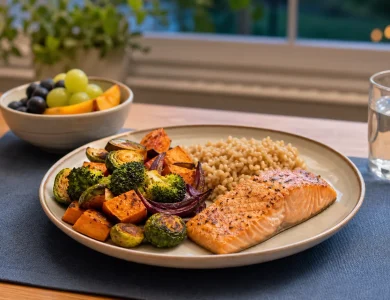
- salmon, rice and broccoli;
- egg tacos with peppers and onions.
Three anchors create a useful shopping list without filling every night. Choose meals that overlap in one or two ingredients but do not taste the same.
In this example:
- broccoli can go with salmon or pasta;
- peppers and onions work in tacos or pasta;
- rice can become a bowl later;
- beans can go into pasta or tacos.
Overlap is helpful. Complete repetition is optional.
Add two flexible meals
A flexible meal uses the ingredients left by the anchors. It is a format, not a recipe.
Reliable formats include:
- a grain bowl;
- soup;
- an omelet or frittata;
- toast with eggs, beans or vegetables;
- a wrap or taco;
- pasta with whatever produce needs attention.
For the sample plan, the two flexible meals might be:
- a rice bowl with leftover salmon or beans and vegetables;
- scrambled eggs with peppers, onions and toast.
Because the exact ingredients are not fixed, these meals can respond to what is left.
Leave two slots open
Open slots are not failed planning. They are what keeps a plan from producing extra food when life changes.
Use them for:
- leftovers;
- a meal from the freezer;
- an invitation or restaurant meal;
- a pantry dinner;
- the anchor meal you postponed.
If you unexpectedly eat away from home, an open slot absorbs the change. If every night is assigned a new recipe, one schedule change can leave several perishable ingredients without a destination.
Shop for ingredient roles
Instead of building a long list recipe by recipe, give each perishable ingredient at least two possible roles.
One leafy or quick-cooking vegetable
Examples: spinach, cabbage, broccoli or frozen mixed vegetables.
Possible roles: pasta, eggs, soup, grain bowl.
One flavor base
Examples: onions, scallions, peppers, garlic or herbs.
Possible roles: nearly every cooked anchor and flexible meal.
One fresh item to eat early
Examples: salad greens, ripe tomatoes, berries or fresh herbs.
Schedule this for the first two days rather than hoping it survives the week.
One long-lasting or frozen backup
Examples: carrots, cabbage, frozen peas, frozen broccoli or canned tomatoes.
This covers the later part of the week.
EPA suggests noting quantities on the list in terms of meals—for example, “salad greens for two lunches”—rather than buying an undefined amount.
Buy smaller only when smaller is actually cheaper for you
The lowest unit price is not always the lowest real cost.
A large package is economical only if you use it. EPA specifically notes that bulk and buy-one-get-one offers save money only when the food is eaten before it spoils.
For one person:
- loose produce may beat a large bag;
- frozen vegetables allow partial use;
- canned beans can be portioned into several dishes;
- bread can be frozen in slices;
- a larger yogurt container may be practical if it appears in breakfast and sauces.
Think in usable servings, not sticker price per ounce alone.
Prep components, not seven finished meals
Cooking every dinner in advance creates sameness. Prepare the parts that remove weekday friction:
- cook a pot of rice or another grain;
- wash and cut durable vegetables;
- make one sauce;
- cook beans or open and portion canned beans;
- roast one tray of vegetables;
- freeze bread in ready-to-use slices.
Then assemble the components differently:
- rice + salmon + broccoli;
- rice + beans + peppers + salsa;
- roasted vegetables folded into eggs;
- vegetables and beans added to pasta.
This gives batch-cooking efficiency without a row of identical containers.
Use an “eat first” area
Designate a visible refrigerator shelf or basket for foods that should be used soon.
Good candidates include:
- half an onion;
- cooked grains;
- open beans;
- ripe fruit;
- leftover vegetables;
- the last serving of a cooked meal.
EPA’s food-waste toolkit recommends an “Eat First” prompt as a visual reminder. The idea works because food hidden behind new groceries is easy to forget.
Keep the area small. If everything is urgent, nothing is.
Food safety sets the boundaries
Reducing waste does not mean stretching leftovers past safe storage guidance.
FoodSafety.gov advises:
- refrigerate perishable leftovers within two hours, or within one hour when the temperature is above 90°F (32°C);
- store leftovers in shallow containers for faster cooling;
- use cooked leftovers within four days;
- reheat leftovers to 165°F (74°C).
The USDA-developed FoodKeeper provides food-specific guidance for refrigerator, freezer and pantry storage.
If a leftover will not be used within the recommended window, freeze it promptly rather than waiting until the final day.
A sample seven-night plan
Monday: Anchor 1
Vegetable and bean pasta. Save one portion for lunch, not four dinners.
Tuesday: Anchor 2
Salmon, rice and broccoli. Cook extra rice for Thursday.
Wednesday: Flexible meal
Egg tacos with peppers, onions and any remaining broccoli.
Thursday: Flexible meal
Rice bowl with beans, vegetables and salsa or another sauce.
Friday: Anchor 3 or an open slot
Cook the remaining planned meal if you are home. If plans change, move it to Saturday.
Saturday: Leftovers or freezer
Use the eat-first shelf before opening new food.
Sunday: Open
Eat out, use the pantry or cook the postponed anchor meal.
The sequence is deliberately movable. A plan that survives a changed Tuesday is more useful than a perfect calendar.
The bottom line
Solo meal planning needs fewer recipes and more escape routes.
Choose three anchor meals with overlapping ingredients, add two flexible meal formats and protect two slots for leftovers or schedule changes. Shop your kitchen first, give perishables more than one role, and freeze food before the safe window closes.
The goal is not a photogenic refrigerator full of containers. It is a week in which the food you bought has a realistic chance of being eaten.
Sources and review notes
- US EPA: Preventing Wasted Food at Home
- US EPA: Food Too Good to Waste Toolkit
- FoodSafety.gov: FoodKeeper App
- FoodSafety.gov: Leftover storage and reheating guidance
- USDA MyPlate: Planning for Savings
This article provides general educational information, not individualized nutrition or medical advice.